Samarkand Agroinnovations and Research University
1,800
Students
1
International students
122
Teaching staff
2
Faculties
5
Departments
2020
Founded
Video and photos
About the university
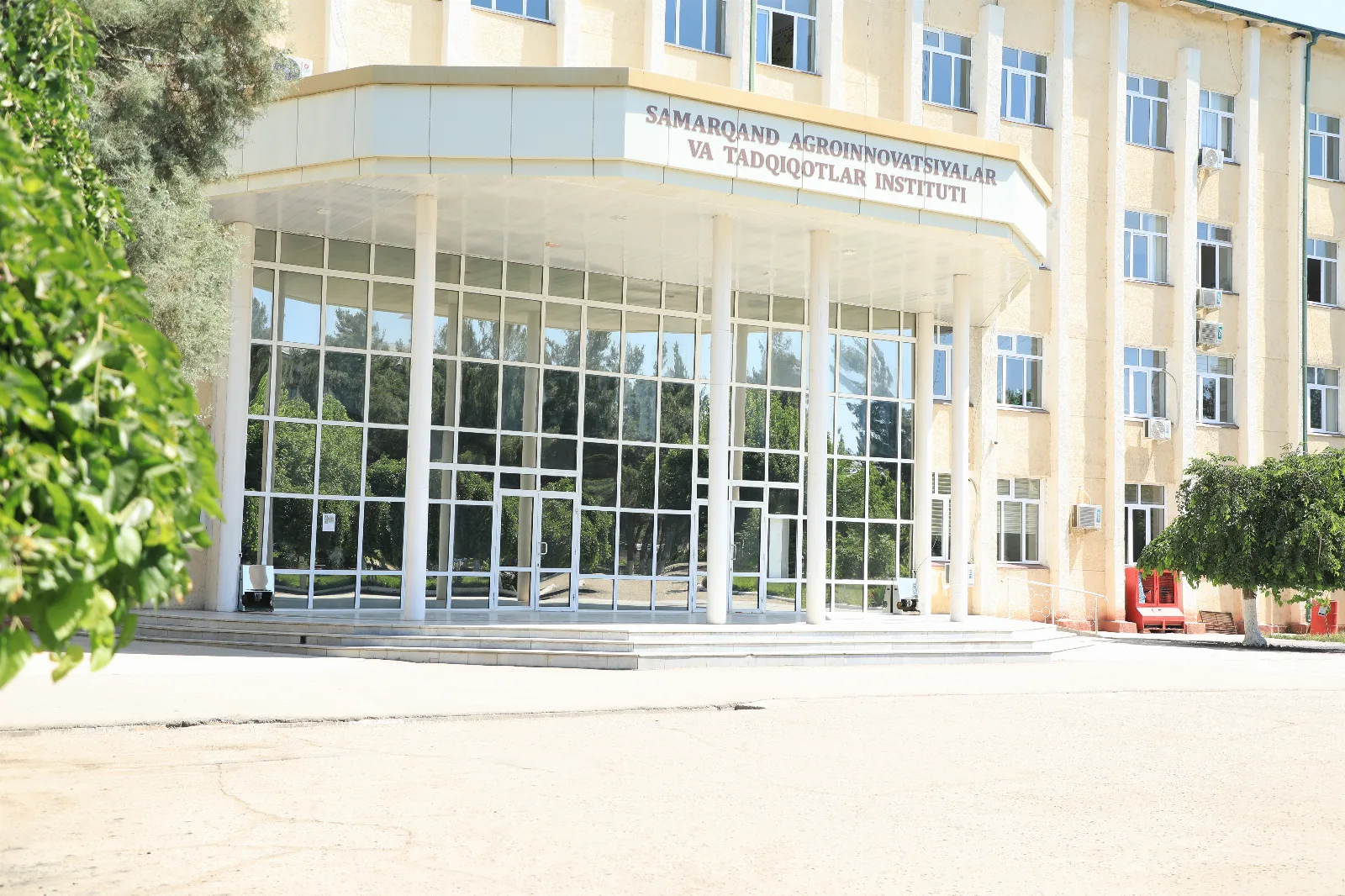
Samarkand Agroinnovations and Research University is a higher educational institution that prepares personnel for the agricultural and food sectors of the economy. The University was established on the basis of Samarkand branch of the Tashkent State Agrarian University based on the decision of the President of the Republic of Uzbekistan No. 216 of July 7, 2023. There are 2 faculties (agrobiology, economics, and management), 5 research centers, 5 departments, 3 laboratories, open and closed sports complexes, and a 50-hectare “Information Advisory Center” for conducting research. Personnel are trained in bachelor's (full-time and part-time), master's, and doctoral forms of education. In addition, the University has established academic cooperation with various universities in countries such as the USA, Germany, Great Britain, Italy, Poland, Latvia, Japan, and South Korea.
In 2025, under an agreement between the Ministry of Agriculture of the Republic of Uzbekistan and the University of Tuscia (UNITUS, Italy), a joint university campus was established at the Institute. The agreement was signed on 28 May 2025 during the visit of Italian Prime Minister Giorgia Meloni, by Uzbekistan's Minister of Agriculture Ibrohim Abdurakhmonov and Tuscia University President Stefano Ubertini, and the joint programmes were officially inaugurated on 3 October 2025. From the 2025-2026 academic year, the campus offers double-degree programmes designed in accordance with European academic standards - undergraduate majors in Agronomy and Food Science and Technology, and master's programmes in Organic Agriculture and Circular Economy. Instruction follows harmonized curricula, is delivered in English and alternates between Uzbekistan and Italy, enabling graduates to obtain diplomas recognized in both countries.
For international students
The Samarkand Agroinnovations and Research University offers international students a modern, comfortable learning environment that meets international standards. Located in the ancient and safe city of Samarkand, the university provides both high-quality education and a rich cultural experience.
Learning environment and infrastructure
- Modern, well-equipped teaching laboratories, multimedia classrooms, and a biolaboratory for practical training;
- A foreign-language training centre and extensive library resources;
- Indoor and outdoor sports facilities and social and recreation areas for students;
- A 50-hectare "Information and Advisory Centre" for internships and research.
International study opportunities
- Joint (double-degree) bachelor's and master's programmes with the University of Tuscia (UNITUS), Italy;
- Cooperation and academic exchange with nearly 50 higher-education institutions in more than 20 countries;
- Classes, seminars, and master classes delivered with the participation of foreign professors and international experts;
- Paid internships and professional-development placements in agriculturally advanced countries such as Germany, Poland, and the United Kingdom.
Student support
- Assistance with documentation, registration, and adaptation;
- Dormitory and accommodation options;
- Individual support from tutors and academic supervisors;
- A comfortable and safe campus environment for international students.
The university is committed to preparing international students as globally competitive specialists in agriculture, food security, and economics.
International partnerships
Main objective of the department
To establish and steadily develop cooperation with foreign higher-education institutions and organizations in order to raise the quality of education and the institute's international standing.
About the department
The International Cooperation Department ensures that faculty and students can study, undertake professional development and internships abroad, and take part in scientific seminars, international conferences and symposia. Through this, it studies advanced international experience and applies the acquired knowledge and skills to the teaching process and to Uzbekistan's agricultural sector. The department's work is aimed at integrating the institute into the global education space, attracting international grants and projects, and creating new opportunities for students and staff.
Functions of the department
- Reviewing and coordinating the documents of institute representatives sent on foreign trips;
- Supporting and monitoring the international projects carried out at the institute and reporting quarterly to the Ministry of Higher Education, Science and Innovation;
- Organizing seminars and round-table discussions for the institute's faculty, staff and students;
- Reviewing, analyzing and advising on agreements, contracts and protocols concluded with foreign partners, and coordinating documents with relevant organizations where necessary;
- Holding seminars and scientific-practical events on priority areas of education together with embassies and international education organizations and foundations operating in Uzbekistan;
- Preparing monthly, quarterly, semi-annual and annual reports on currency revenues from educating foreign citizens, at the ministry's request;
- Recommending the institute's faculty, researchers, master's students and undergraduates for grant competitions for internships, professional development, courses, master's and doctoral study announced by foreign partners;
- Collecting and disseminating information on international grants, assisting departments in preparing projects, and participating directly in their implementation;
- Collecting information on international events, conferences and seminars and conveying it to the faculties.
International academic mobility (2025–2026)
The institute steadily expands the international mobility of its faculty and students every year. In 2025 alone, more than 50 faculty members and senior staff travelled to 13 countries — Italy, Germany, the Netherlands, Japan, South Korea, China, Turkey, Poland, Slovakia, Portugal, Finland, Latvia and Tajikistan — for academic visits, professional development and cooperation talks. In addition, more than 240 students, master's students and young researchers took part in internships, academic exchange and professional-development programmes at foreign universities and companies.
Key visits of the year included the Rector's trips to China (the "China – Central Asia" summit in Urumqi), the Netherlands (Wageningen University), South Korea (the National Institute of Horticultural and Herbal Science), Germany (the Uzbekistan–Germany rectors' forum, University of Rostock) and Japan (Tokyo University of Agriculture and Technology, JICA project), as well as the visits of the head of the International Cooperation Department to Poland, Finland (University of Oulu) and Italy (University of Tuscia, discussions on the "Joint Campus" programmes). In the first half of 2026 this momentum grew further, with faculty visits to Italy (Roma Tre University, the AIEAA agricultural economists' conference), Japan, Malaysia (Sultan Idris University), China, Kazakhstan, South Korea (Wonkwang University) and Sweden.
International projects
The institute is an active participant in a number of prestigious projects under the European Union's Erasmus+ programme:
- BioEcoUz — developing a new curriculum on sustainable bioeconomy in Uzbekistan;
- OFINU — the "Open University" project for introducing food innovations;
- MIND — an international academic networking and development project;
- BioDigiskills — developing digital and bio-skills (Latvia);
- Agricool — an agricultural practice and innovation project (Poland);
- Erasmus+ ICM (International Credit Mobility) and CBHE (Capacity Building in Higher Education).
In addition, a project to raise rural incomes through persimmon drying is being carried out in the Samarkand region with the support of Japan's JICA agency.
Student internships and international exchange
Every year, more than 200 students undertake paid production internships in agriculturally advanced countries. The largest stream is the internship programme with leading agricultural enterprises in Germany ("Schneiders Obsthof", "Mühlenhof Zepelin", "FVG Fruchtveredelungsgesellschaft Bonn", "BioBördeland", "HegeLand", "Obsthof Hubertus Wolf" and others). Students also pursue professional development in Slovakia (Slovak University of Agriculture in Nitra — one-semester exchange), Poland (Krakow Agricultural University and the Green Crops company under the "Agricool" project) and South Korea. These internships allow students to absorb world experience, improve their foreign-language skills and become competitive on the international labour market.
Scientific cooperation and international events
The institute's representatives took part in the "China – Central Asia industry, education and research integration" summit, the Uzbekistan–Germany rectors' forum, the AIEAA (Italian Association of Agricultural and Applied Economics) international conference and scientific events in Turkey, Kazakhstan and other countries, reaching agreements on joint research projects, articles and studies.
Foreign partners (agreements and contracts)
🇩🇪 Germany
- Internship International LLC — agricultural internship programme (20.10.2020–2025);
- "Praktikum 4 people" — internship programme (15.04.2021–2026);
- "JD East" — student internship programme (01.04.2021–2026);
- IAMO institute — research and early-career staff development (04.01.2023–2028);
- "LOGO e.V." — sending students for internships (22.02.2023–2028);
- "NÜRNBERGER" programme — professional development (10.10.2023–2029);
- "STAFF & DA" programme — professional development (24.10.2023–2028);
- University of Rostock — rectors' forum and scientific cooperation (2025).
🇫🇮 Finland
- JAMK University of Applied Sciences — Erasmus+ BioEcoUz (21.05.2021–2026);
- University of Oulu — Erasmus+ ICM/CBHE cooperation (2025).
🇱🇻 Latvia / 🇱🇹 Lithuania
- Vytautas Magnus University — Erasmus+ BioEcoUz (21.05.2021–2026);
- Latvia University of Life Sciences and Technologies — cooperation memorandum (02.03.2022–2027);
- Bulduri Technical School — "BioDigiskills" project (2025).
🇰🇷 South Korea
- Jeju National University — student exchange programme (14.04.2021–2026);
- Andong National University — academic and scientific cooperation (31.01.2024–2029);
- International Horticultural Institute and the National Institute of Horticultural and Herbal Science — joint project on potato seed production (2025).
🇷🇺 Russian Federation
- South Ural State Agrarian University (01.12.2021–2026);
- Institute of Plant Physiology of the Russian Academy of Sciences (29.09.2021–2031);
- Orel State Agrarian University named after N.V. Parakhin (16.06.2021–2026).
🇵🇱 Poland
- Warsaw University of Life Sciences – SGGW (01.04.2022–2027);
- Krakow Agricultural University, University of Rzeszów and the Ignacy Mościcki University of Applied Sciences — "Agricool" project (2024–2025).
🇨🇳 China
- Annexure Financial Solutions Ltd (Hong Kong) — academic and scientific cooperation (20.02.2022–2025);
- Xinjiang Agricultural University (XJAU) (24.02.2023–2028);
- Shihezi Agricultural University — "China–Central Asia" summit and student exchange (2025).
🇰🇿 Kazakhstan
- Atyrau University (24.02.2023–2028);
- Abylkas Saginov Karaganda Technical University (2024–2029);
- Kazakh National Agrarian Research University (2025–2026).
🇹🇷 Turkey
- Isparta, Siirt and Çoruh universities (14.11.2023–2028);
- Ondokuz Mayıs University and Kahramanmaraş Sütçü İmam University (2025).
Other countries
- 🇭🇺 Hungary — Hungarian University of Agriculture and Life Sciences (MATE) (30.01.2023–2028);
- 🇮🇪 Ireland — IICRR (14.04.2023–2028);
- 🇬🇧 United Kingdom — "HOPS" company, professional development (20.11.2023–2028);
- 🇳🇱 Netherlands — Wageningen University (2025);
- 🇯🇵 Japan — Tokyo University of Agriculture and Technology (2025–2026);
- 🇲🇾 Malaysia — Sultan Idris University (2026).
Erasmus+ International Credit Mobility (ICM) projects:
- 🇷🇴 University of Agricultural Sciences and Veterinary Medicine of Cluj-Napoca (Romania, 2022–2023);
- 🇵🇹 University of Porto (Portugal, 2022–2023);
- 🇧🇬 D. A. Tsenov Academy of Economics – Svishtov (Bulgaria, since 2022).
Joint campus with the University of Tuscia (Italy)
The largest and most promising outcome of international cooperation is the joint university campus established with the University of Tuscia (UNITUS, Viterbo, Italy). Launched on the basis of an agreement signed on 28 May 2025 between Uzbekistan's Ministry of Agriculture and the University of Tuscia, the initiative delivers double-degree programmes from the 2025–2026 academic year: at bachelor's level — Agronomy, and Food Science and Technology; at master's level — Organic Agriculture, and Circular Economy. Instruction follows European standards, is delivered in English and alternates between Uzbekistan and Italy; graduates receive diplomas recognized in both countries.
Language courses
The Samarkand Agroinnovations and Research University regards the study of foreign languages as an essential condition for educating globally competitive specialists. In a globalized world, language skills open the way for students to draw on the achievements of world science, take part in international joint programmes, undertake internships and professional development abroad, and make full use of academic exchange opportunities.
At the university's foreign-language training centre, language courses are organized for students and faculty using modern, communicative methodologies. Classes are held in small groups according to proficiency level (from beginner to advanced) and are designed to develop speaking, listening, reading, and writing skills simultaneously. The centre also offers preparation for international language certification exams (IELTS, TOEFL, Goethe-Zertifikat, TOPIK, JLPT, and others).
The following languages are currently available:
- English — the main language of international education, scientific publication, and joint programmes;
- Russian — for regional and scientific cooperation;
- German — for internships and professional-development programmes in Germany;
- Turkish — for exchange and scholarship programmes with Turkish higher-education institutions;
- Korean — within cooperation with Korean universities and grant programmes;
- Japanese — to strengthen educational and scientific ties with Japan.
As international cooperation expands, the university continues to enrich its language offerings. In the near future, it plans to introduce Italian courses — directly linked to the joint education programme and double-degree tracks with the University of Tuscia (UNITUS), Italy. It also intends to organize Chinese courses: recently, more than 15 of the university's students were sent to China for language-study programmes, reflecting the strengthening educational ties between the two countries.
The language courses not only enhance students' professional and academic potential but also build a solid foundation for their integration into the global education space, participation in international projects, and future international careers.
Opportunities for students
1 winner of the scholarship of the President of the Republic of Uzbekistan and 2 winners of the state scholarship named after Islam Karimov, established in order to further encourage and financially support students' activities in educational and scientific research work. Also, 6 of our talented students won the "Scholarship of the Ministry of Agriculture of the Republic of Uzbekistan" organized by the Ministry of Agriculture of the Republic of Uzbekistan. The "Rector's scholarship" established by the rector of the institute is awarded to 2 talented students from the faculties every academic year, including 32 talented students who have received the "Rector's scholarship" so far.
Faculties
Decision PQ-216 of the President of the Republic of Uzbekistan dated July 7, 2023 "On additional measures to increase quality and efficiency by integrating science, education and production in the agricultural sector" in order to ensure the implementation of the decision No. 556 of the Cabinet of Ministers of the Republic of Uzbekistan "On organizing the activities of the Samarkand branch of Tashkent State Agrarian University" and No. 155 of the Ministry of Agriculture of the Republic of Uzbekistan dated September 18, 2020 It was established on the basis of the branch structure in Appendix 1 of Order No.
From September 2023, the Samarkand Agricultural Innovation and Research Institute was renamed the Faculty of Economics and Management.
60310100-Economics (in agriculture), 60410100-Accounting and auditing (in agriculture), 60411300-Business management (in agriculture), 60412400-Agribusiness and investment activity, 60411700-Logistics (agro-logistics), 61010400 -Tourism (agritourism), 60610200-Information systems and technologies (digital technologies in agriculture), 60810100-Mechanization of agriculture, 60811300-Technology of storage and preliminary processing of agricultural products (by product types), 5311000 -Automation and management of technological processes and production (in agriculture), 60811500-Bachelors in zooengineering (poaching), 70310102-Economics (in agriculture), 70310201-Econometrics, 70410101 -Accounting (in agriculture), 70811301-Technology of storage and initial processing of agricultural products ( for field crops and fruit and vegetable products ), 70810101-Mechanization of agriculture, 70310109-Bioeconomy international master's specialties masters and 08.00.04-Agricultural economy, 05.07.01-Agriculture and reclamation machines. Mechanization of agriculture and land reclamation works, 06.01.11-Agricultural product storage and processing specializations, qualified personnel are being trained in the basic doctoral studies.
Today, the faculty has "Economics and Business", "Digital Technologies and Accounting", "Agroengineering" and "Food Safety and Technology" departments, which have 7 doctors of science, 21 candidates of science (including philosophical sciences Doctor (PhD) 13), 2 Ph.D.'s experienced team of professors and teachers, consisting of compatriots from abroad. At the same time, 6 young scientists who have successfully completed master's courses in the world's top 1000 prestigious foreign universities are working as assistants and senior teachers. 937 bachelors, of which 349 in the 1st year, 296 in the 2nd year, 213 in the 3rd year, 79 in the 4th year, 16 masters in the 1st and 2nd year, 16 masters in 6 academic groups are studying at the faculty.
The team of the faculty is involved in the development of rural areas and its economy and management, the development and digitization of accounting and auditing services, agrologistics, agrotourism, agribusiness and investment activities, the development of modern, resource-efficient technologies in agriculture, agricultural machinery and mechanisms. improvement of mechanization work aimed at increasing the efficiency of production, reducing labor costs, stabilizing technical service areas, eliminating problems related to automation and management of repair and product processing processes, and adapting modern product storage technologies to the conditions of Uzbekistan are conducting scientific research.
DEPARTMENTS AVAILABLE IN THE FACULTY
T/r Department name
1 Department of Economics and Business
2 Department of Digital Technologies and Accounting
3 Department of Agroengineering
4 Department of Food Safety and Technology
QUALIFICATION REQUIREMENTS
Undergraduate Education Qualification Requirements
• 60310100-Economy (in agriculture)
• 60410100-Accounting and auditing (in agriculture)
• 60411300-Business management ( in agriculture)
• 60412400-Agribusiness and investment activity
• 60411700-Logistics (agro-logistics)
• 61010400-Tourism (agritourism)
• 60610200-Information systems and technologies (digital technologies in agriculture)
• 60810100-Mechanization of agriculture
• 60811300-Technology of storage and initial processing of agricultural products (by product types)
• 5311000-Automation and control of technological processes and production (in agriculture)
• 60811500-Zooengineering (piracy)
Master's majors qualification requirements
• 70310102- Economy ( rural in the farm )
• 70310109- Bioeconomy international master's degree
• 70310201- Econometrics
• 70410101-Accounting (in agriculture)
• 70811301-Technology of storage and initial processing of agricultural products (by product types)
• 70810101- Village farm mechanization
The decision No. 556 of the Cabinet of Ministers of the Republic of Uzbekistan of the Faculty of Agrobiology dated September 16, 2020 "On the organization of the activities of the Samarkand branch of the Tashkent State Agrarian University" and No. 155 of the Ministry of Agriculture of the Republic of Uzbekistan dated September 18, 2020 was established on the basis of the branch structure in Annex 1 of the order. Today, the faculty has 4 departments.
Faculty of Agrobiology, the Law of the Republic of Uzbekistan "On Education", the Decree of the President of the Republic of Uzbekistan "Additional measures to ensure the academic and organizational-management independence of state higher education institutions" "On", the Ministry of Higher Education, Science and Innovation of the Republic of Uzbekistan, operates on the basis of the relevant orders and instructions of the rector of the institute.
Curricula and science programs of undergraduate education are improved based on the experiences of leading higher education institutions of foreign countries in cooperation with international experts. The educational process of students and masters of the faculty is based on the full credit-module system.
In accordance with the training schedule established during the internship period of the students, in the agricultural departments of the Ministry of Agriculture, Ministry of Water Management of the Republic of Uzbekistan, regional, city and district administrations and various other clusters and enterprises. z has the opportunity to put theoretical knowledge into practice and become familiar with current news, guidelines, decisions and laws during the internship.
Our faculty has a total of 69 professors, namely: 7 doctors of science, 20 candidates of science, 4 senior teachers, 38 assistants.
The community of the faculty develops and manages rural areas, grows and digitizes agricultural products at higher quality and lower prices, develops modern resource-saving technologies in agriculture, creates varieties that high-yielding, resistant to disease and pests, eliminates the problems of plant disease and pest control. They are carrying out research works on overcoming the problems of the production and adaptation of modern storage technologies to the conditions of Uzbekistan.
MISSION OF THE FACULTY
Making a worthy contribution to the development of sustainable agriculture and society, training highly educated personnel as specialists and leaders.
The main directions of the mission:
• training of a new generation of agricultural specialists and managers who have creative abilities for agricultural industries, who make innovative decisions in the implementation of acquired knowledge;
• making a worthy contribution to the development and introduction of innovative technologies to ensure the country's economic growth;
• to ensure the continuous development of the faculty's activities based on the best agricultural practices of leading foreign countries;
• scientific justification of solutions to problems in our region within the framework of integration of science, innovation, education and production;
• to produce highly employable graduates as specialists and leaders.
DEPARTMENTS AVAILABLE IN THE FACULTY
T/r Department name
1 Chair of Botany and Horticulture,
2 Chair of Agrochemistry, Soil Science and Plant Protection
3 Department of fundamental and humanitarian sciences
4 Department of Agrobiotechnology
YOUTH ISSUES AND SPIRITUAL-EDUCATIONAL ACTIVITY OF THE FACULTY
In the faculty of agrobiology, the implementation of the tasks given in the decrees, decisions of the President of the Republic of Uzbekistan, decisions of the Cabinet of Ministers, decisions, orders and modems of the Ministry board on youth issues and the spiritual-educational sphere at a high level and within the time limit, great attention is being paid to quality assurance of the implementation of the adopted State Programs.
Ministry of Internal Affairs of the Republic of Uzbekistan, Republic of Uzbekistan in order to further increase the effectiveness of youth issues and spiritual-educational seminars, spiritual-educational events, meetings and roundtable discussions held at the faculty Ministry of Agriculture, Office of Muslims of Uzbekistan, Samarkand Regional Representative Office of Muslims of Uzbekistan, Samarkand Regional Department of Internal Affairs, Prosecutor's Office, Department of Justice, Regional Council of the Youth Affairs Agency of Uzbekistan, regional and district Spirituality and spirituality rifat departments, Reproductive Health Center, Regional AIDS Center, Narcology Dispensary, School of Hadith Science, neighborhoods, various public organizations, orphanages, military units, trade union organizations, city and district administrations and a number of organizations To increase the effectiveness of spiritual and moral educational activities, to clarify the content and nature of the socio-political, economic reforms, adopted laws, and the complex geopolitical and ideological-ideological processes taking place in the world. , to carry out an effective ideological struggle against various threats, to form a healthy worldview in young people, to strengthen their ideological immunity against information attacks, to preserve the historical heritage, customs and traditions of national education of our people, and crime among young people, spiritual and educational events, roundtable discussions and meetings aimed at preventing crime and corruption are being organized, and the participation of students and young people of the faculty is being ensured.
Within the framework of five important initiatives, clubs named "Student Theater Studio", "Kuvnog va Zukkolar", "Sports Students", "Computer Scientists", "Bakhs-munozara", "Zakovat", "Stars of the Fifth Initiative" were organized in the faculty. has been established.
Also, exhibitions, spiritual and educational events, meetings, competitions, sports competitions, reading and poetry reading nights are held at the faculty level during the year as part of five important initiatives.
Currently, the faculty is preparing a collection of volumes containing the list of students living in rented apartments, their addresses and information about the owners of rented apartments, monitoring them throughout the year, and renting apartments during the academic year., divided into yellow and green categories, the conditions of rental apartments and living conditions of students are being studied.
PRIORITY DIRECTIONS OF SCIENTIFIC RESEARCH ACTIVITY OF THE FACULTY
• studies soil productivity, quality indicators, properties and characteristics, and measures to improve them. Special attention is paid to the study of soil fertility, ecological and land reclamation conditions;
• dedicated to the study of the agrochemical properties of the soil and plant nutrition, as well as the effect of mineral and organic fertilizers on the growth, development, yield and product quality of agricultural crops. At the same time, he deals with issues of improving the fertilization system of agricultural crops;
• related to the protection of agricultural crops from pests, diseases and weeds, plant quarantine, study of the effect of pesticides, development of biological, chemical and combined protection methods;
• in plant science, agrotechnics of new varieties of agricultural crops are developed, maintenance technology is created, introduced crops and their varieties are acclimatized, and optimal cultivation technologies are created.
• horticulture and polyculture, introducing new types of vegetable crops, improving the technology of cultivation in main and repeated crops, regionalization of new varieties and hytrosis hybrids, development of resource-efficient technologies in cultivation
• fruit growing and viticulture, in this direction, development of clonal grafts for the cultivation of intensive fruit crops, improvement of agrotechnics of nurseries, young and productive orchards, creation of agrotechnical activities in viticulture, such as the cultivation of vines in the modern intensive method of vertical symbags
• engages in agrotechnical activities aimed at increasing the yield and quality of field crops in the field of general farming, i.e. studying soil fertility, quality indicators, properties and characteristics, as well as measures to improve them, fight against weeds, and protect against diseases and pests.
• to carry out large-scale work on the creation of new varieties and hybrids of all agricultural crops in this direction, considering the selection and seed production of agricultural crops. Introduction of advanced technologies in selection and seed production of agricultural crops of agriculturally developed countries in Uzbekistan
• conducts scientific research in social and humanitarian sciences, history, philosophy, Russian, English and physical education;
Fields of full-time undergraduate education
• 60810700-Agrochemistry and agro-soil science
• 60810900-Agronomy (by types of agricultural products
• 60811000-Plant protection (by types of crops)
• 60811100-Quarantine of plants and agricultural products
• 60811200-Selection and seeding of agricultural crops (by types of crops)
• 60811800-Fruit and Viticulture
• 60811900-Vegetable, horticulture and potato growing
• 60812000-Organizing and management of greenhouses
• 60812100- Technology of cultivation and processing of medicinal plants
• 60820100-Forestry and greening of residential areas
Courses of part-time undergraduate education
• 60810900-Agronomy (by types of agricultural products)
Master's specializations
• 70810702- Agrochemistry
• 70810902- Botany (by crop groups)
• 70810903- Organic farming and food security
• 70811001- Plant Protection (by methods)
• 70811201- Breeding and seed production (by crop groups)
• 70811901- Vegetable and horticulture
• 70812101- Technology of cultivation of medicinal plants
Fields of study
| Accounting and auditing (in agriculture) 60410200 | Bachelor Master's |
| Agricultural mechanization (by sectors) 70810101 | Bachelor Master's |
| Agrochemistry 70810702 | Master's |
| Agrochemistry and agro-soil science. 60810100 | Bachelor |
| Agronomy 60810400 | Bachelor |
| Applied Mathematics and Informatics 70410201 | Master's |
| Biznesni boshqarish (qishloq xo‘jaligida) 60411300 | Bachelor |
| Crop Production 70810402 | Bachelor Master's |
| Econometrics 60310200 | Master's |
| Economics 60310100 | Bachelor Master's |
| Economics (in agriculture) 60З10100 | Bachelor |
| Economy 60410100 | Master's |
| Field of study: Fruit and vegetable growing and viticulture 60811000 | Bachelor |
| Field of study: Quarantine and protection of plants 60811000 | Bachelor |
| Field of study: Technology of cultivation and processing of medicinal plants 70811101 | Master's |
| Food production and processing technology (canned food, meat, dairy and fish products) 70720101 | Master's |
| Food technology. 60720100 | Bachelor |
| Information systems and technologies (by fields and sectors) 60610100 | Bachelor |
| Organic farming and food security 70810903 | Master's |
| Plant Breeding and Seed Production 70810601 | Master's |
| Plant quarantine and protection (by methods) 70811001 | Master's |
| Selection and seed production of agricultural crops. 60810600 | Bachelor |
| Technology of Storage and Processing of Agricultural Products (by product types) 60811300 | Bachelor Master's |
| Tourism and Hospitality 71010101 | Master's |
| Vegetable farming 70811901 | Bachelor Master's |
| Vegetable, rice and potato growing 60811900 | Master's |
| Veterinary sanitary expertise 60840300 | Bachelor |
| Viticulture and winemaking 70811803 | Master's |
| Zootechnician, teacher-researcher 70810803 | Master's |
| Аtrof muhit muhofazasi 70520201 | Master's |
Programmes
All programmes →
Samarkand Agroinnovations and Research University
Economics
15 750 000 so'm
per year
Samarkand Agroinnovations and Research University
Tourism and Hospitality
19 400 000 so'm
per year
Samarkand Agroinnovations and Research University
Zootechnician, teacher-researcher
17 936 000 so'm
per year
Samarkand Agroinnovations and Research University
Аtrof muhit muhofazasi
17 936 000 so'm
per year
Samarkand Agroinnovations and Research University
Applied Mathematics and Informatics
24 000 000 so'm
per year
Samarkand Agroinnovations and Research University
Information systems and technologies (by fields and sectors)
14 166 000 so'm
per year
Samarkand Agroinnovations and Research University
Economics
18 045 000 so'm
per year
Samarkand Agroinnovations and Research University
Selection and seed production of agricultural crops.
11 100 000 so'm
per year
Samarkand Agroinnovations and Research University
Food technology.
11 100 000 so'm
per year
Samarkand Agroinnovations and Research University
Economy
24 000 000 so'm
per year
Samarkand Agroinnovations and Research University
Organic farming and food security
17 936 000 so'm
per year
Samarkand Agroinnovations and Research University
Organic farming and food security
17 936 000 so'm
per year