
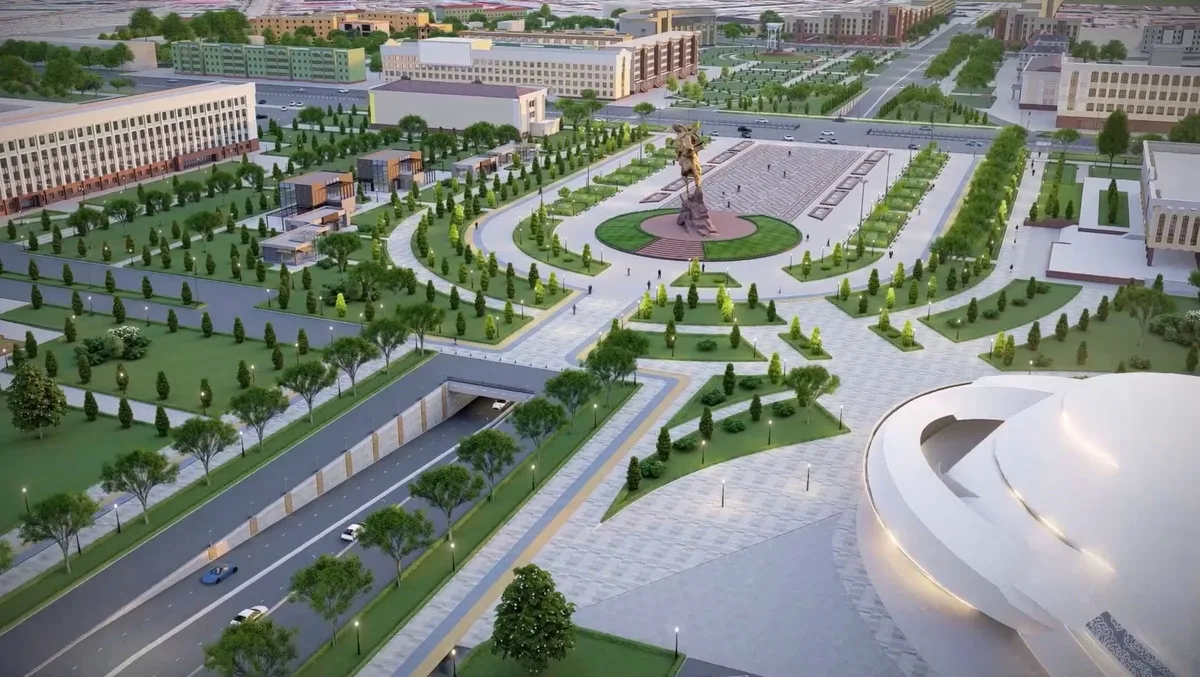
Ciudad de Urgench
Región de Jorezm
157,200
Población
8
Universidades
3
Museos
12
Bibliotecas
1
Aeropuertos
1
Estaciones de tren
General information about the city
The city of Urgench - The city in the Khorezm region of the Republic of Uzbekistan is the administrative, economic and cultural center of the region. It is located on the left bank of the lower reaches of the Amu Darya. The city of Urgench was founded in 1646 by Abulgazi Bahodirkhan, Khan of Khiva. Urganch), which became a rapidly developed trade and craft centre due to its location on the Great Silk Road. During the Oghli Anushakhan (Anushashoh) of abulghazi Bahodir Khan (1664-89), a large canal was dug near New Urganch, giving it the name Shohabad (Shovot).
Main sights
Visit the main sights of Urgench:
- Avesto garden-complex - The sacred book of Zoroastrianism-a symbolic statue and garden complex installed in the "Avesto" is located on the Right Bank of the Shovot canal flowing from the city of Urgench. The book of Avesto was built on the 2700th anniversary of its creation;
- Jaloliddin Manguberdi complex - A new statue in honor of Jalaliddin Manguberdi, sarkard of the khorezmshahlar state. This statue is made of bronze and raised in Urganch, Khorezm region. And in front of the statue is also installed a scroll with verses from the Quran, the Shajara of Jaloliddin Manguberdi;
- Al-Khwarazmi complex – this complex consists of a symbolic mausoleum and a garden. The Al-Khwarazmi architectural complex was built on the basis of medieval building traditions. This complex consists of a symbolic mausoleum and a garden. The Al-Khwarazmi architectural complex was built on the basis of medieval building traditions. An orchard and an exposition of the Al-Khwarazmi museum are organized in the AL-Khwarazmi architectural complex;
- Al-Beruniy complex - The complex consists of a gate and a symbolic mausoleum. The mausoleum was built domed in the architectural style of the Khorezmshah period. In the architectural complex there is also an exposition about the life and work of Berunius;
- Komiljon Otaniyazov creative center – The creative center named after Komiljon Otaniyozov was established in 2017, in the area near the Shovot anhori of Urgench district. In the center there are many exhibits reflecting the life and work of the Great hofiz Komiljon Otaniyozov;
- Doshkinjon Bobo Shrine - "Doshkinjan Bobo Shrine" is a religious monument with historical, architectural, aesthetic, and socio-cultural value and is one of the few historically blessed places in the city of Urganch. It was built in 1646–1648 by Abulgazi Bahadirkhan, the founder of the city of New Urganch. In fact, there is a cemetery in the place of the mausoleum, and it is connected with the name of Sa'd ibn Abu Waqqas, the Arab general who came to Khorezm in the VII–VIII centuries. As a result of the Amudarya overflowing twice a year, the residents, who watched the water that reached this cemetery recede, called him the holy saint Doshkinjan Bobo. The mausoleum fell into ruins from 1648 to 1826. In the 19th century, Khan of Khiva Olloquli Khan repaired and improved it and built the present-day mausoleum. According to Ogahi's book "Riyazud-davla," the mausoleum of Grandfather Doshkhinjan was built based on the order of Khiva Khan to build four salable mausoleums (the rest are located in the city of Khiva, Yangiariq District (Astana (White Mosque), in the territory of the Republic of Karakalpakstan). Mausoleum of Sultan Uwais) was built. During the Soviet period, the mausoleum was closed, and it was used as a prison until 1939. In 1980, it was renovated and turned into an archive. In 1991, it was handed over to the Office of Muslims of Uzbekistan. In 2005, in connection with the celebration of the 1000th anniversary of the Mamun Academy, it was renovated and improved. At the moment, the office of the Muslims of Uzbekistan is being used as a representative office of the Khorezm region and a place of pilgrimage;
- Statue Abulgazi Bahadir Khan - Abulgazi Bahadirkhan is a representative of the Shaibani dynasty, an accomplished historian and ruler. He was forced to spend many years of his life in other countries due to disputes over the throne between his brothers. Finally, after many struggles, in 1644, the Khanate of Khiva took over the throne. Abulghazi Bahadir Khan fought for the strengthening of the central power, and during the years of his reign, social and political life in the khanate stabilized. In 1646, Abulgazi Bahadirkhan founded the city of New Urganch (now Urganch). He is also a remarkable person and a great historical scientist. His works "Shajarayi Tarokima" and "Shajarayi Turk" are valuable sources for the history of Uzbekistan and Central Asia in general. Abulghazi Bahadirkhan also wrote a work on medical science called "Manofi'ul Insan" ("Things useful to man"). In 1997, a statue was erected in the city of Urganch in memory of Abulghazi Bahadirkhan;
- Museum of Repression Victims - The Museum of Repression Victims is one of the young museums opened in the years of independence, located in the central part of the city of Urganch. By the decision of our government on November 22, 2017, the work on the establishment of the museum began, and the museum began its activity on August 31, 2018. With the active participation of professors and teachers, young scientists and students, and the general public, the museum fund has been enriched with archival documents, the Central State Archive of Uzbekistan, and the materials of the Ichan-Kala Museum Fund. The museum also includes materials collected in cooperation with representatives of the Korean diaspora who were deported to the Khorezm region in 1937. In the first year of the museum's establishment, more than 2,300 historical documents were collected, and now the total fund of the museum includes more than 4,000 materials. The museum includes 3 exhibition halls and 8 departments. In them, you can get acquainted with exhibits depicting the processes from the conquest of the Khiva Khanate by the Russian Empire to the hardships and massacres of the Soviet era and the first periods of independence;
- Okhun Bobo Mosque - Okhun Bobo Mosque is a religious shrine built in the last century in the form of a mosque in Urganch, the central city of the Khorezm region, and has been used for years. On January 28, 2017, President Shavkat Mirziyoyev personally laid the foundation stone for the construction of the "Okhun Bobo" mosque during his practical visit to the Khorezm region. those who expressed their opinions. In 2018, the mosque, which can accommodate 4,000 people, was put into use on the day of Ramadan, and today it is one of the main religious and cultural objects of the city of Urganch. The mosque stands out in Uzbekistan with its unique architecture. In Khorezm, the personality of Grandfather Okhun was honored as a saint and a bright mystic, and this mosque was named in his honor. Grandfather Okhun was a religious leader and one of the representatives of Sufism who lived and worked in Khiva Khanate for many years. He died in 1773 at an old age;
- Avesta Museum - In the center of the city of Urganch, on the banks of the Shavot canal (Shahabad), in the complex of the "Avesto" recreation park, there is a museum of "History of Zoroastrianism" belonging to the "Golden Heritage" fund. Founded in 2001, the museum is located in the buildings under the amphitheater, and its collection includes more than 2,000 exhibits collected by museum lovers and the public. Most of the exhibits belong to the Zoroastrian era and testify to the history of the birth of this ancient religion in the oasis on the shores of the Amudarya (Oxus-Jayhun) and the Aral Sea. Among the exhibits in the "Avesto" museum, there are many unique ones. These are a petrified tree (about 85–90 million years old), ceramic and wooden household items from the 1st–2nd centuries BC, a majolica plate from the 9th–10th centuries, the manuscript of Alisher Navoi's book "Khamsa" (15th century), and others. The ambassadors of the United States of America, India, Iran, China, Korea, Poland, Hungary, Armenia, the Russian Federation, and many other countries left their comments in the visitor book of the museum;
- Museum of Modern Art of Uzbekistan (CAMUZ) - The Museum of Modern Art of Uzbekistan (CAMUZ) is one of the unique museums in the form of a picture gallery located in Urganch. It was first opened in 1983 in the city of Urganch, in the first post office building built in 1910. Today, the Museum of Modern Art of Uzbekistan has two branches where you can get acquainted with the exhibits: 1. "Lazgi" museum in Urganch; 2. House Museum of Hafiz Komiljon Otaniyozov in Urganch. The museum offers visitors about 1,000 selected paintings, graphics, and sculptures in permanent exhibitions. The doors of the museum are open not only to the artists of Uzbekistan but also to representatives of the art of other nations and cultures. Exhibitions have been held and are being organized here in cooperation with representatives of Japan, the People's Republic of China, Poland, Switzerland, and other countries. The museum consists of 4 halls in total: 1. the sculpture hall; 2. the hall of Khorezm masters; 3. the graphics hall; and 4. the hall of modern art. The museum also has an auction hall and an ever-growing library.
Klimat. The climate of the Khorezm region is a dry continental climate, the summer months of which can be characterized as hot and arid, and the winter months as less humid and cold. Therefore, do not forget to bring an umbrella and sunscreen when traveling to Khorezm at this time of the year.
Kitchen. The process of cooking Uzbek national dishes and food culture have a very long history and are based on the long-term experience of the people. Customs and traditions were formed based on the climatic conditions of the area and the lifestyle of the local population. Residents of each region have their own style of cooking national dishes. Khorezm region is especially famous for its dishes and its special style of cooking. Each dish has its own special taste, especially "Khorezm pilaf", "Tukhum barak", "Ushak barak", "Shivit oshi", fried fish, etc.
Universidades
Academia Estatal de Coreografía de Uzbekistán, sucursal de Urganch”

Universidad de Innovación de Urganch
Instituto Médico Estatal de Urgench
Al-Xorazmiy universiteti
Instituto Pedagógico Estatal de Urgench
Mamun University

Universidad de Tecnología de Urganch RANCH