

M.V. Lomonosov nomidagi Moskva davlat universitetining Toshkent shahridagi filiali
934
Studierende
25
Internationale Studierende
42
Lehrpersonal
7
Fakultäten
3
Lehrstühle
2006
Gegründet
Videos und Fotos
Über die Universität
The Branch was established pursuant to Resolution No. PP-290 of the President of the Republic of Uzbekistan dated February 24, 2006, “On the Organization of the Activities of the Branch of Lomonosov Moscow State University in Tashkent.”
The principal mission of the Branch is to train highly qualified specialists in accordance with the academic standards adopted by Lomonosov Moscow State University, internationally recognized requirements for the quality of higher education, and the goals and objectives of the National Program for Personnel Training of the Republic of Uzbekistan.
The activities of the Branch are carried out in compliance with the legislation of the Republic of Uzbekistan and the Russian Federation.
The admission of applicants and the certification of graduates of the Branch are conducted in accordance with the requirements, procedures, and deadlines established by Lomonosov Moscow State University.
Instruction at the Branch is provided in accordance with curricula and academic programs approved by Lomonosov Moscow State University.
The diploma issued to graduates of the Branch, in the established format certifying graduation from Lomonosov Moscow State University, is recognized as a higher education qualification document in the Republic of Uzbekistan.
Für internationale Studierende
Lomonosov nomidagi Moskva davlat universitetining Toshkentdagi filialining Test markazi
rus tilini chet tili sifatida oltita darajada (A1–C2) testdan o'tkazadi;
xorijiy fuqarolarga test masalalari bo'yicha ma'lumot va maslahat beradi;
davlat tomonidan berilgan sertifikatlarni qayta ishlaydi va beradi.
Internationale Partnerschaften
The Tashkent branch of Lomonosov Moscow State University collaborates with organizations such as: - The Moscow Gestalt Institute representative office in Kazakhstan
- The M. Kh. Dulati Taraz University
- The M. Auezov South Kazakhstan University
- The E. A. Buketov Karaganda University
- The Lomonosov Moscow State University.
Sprachkurse
Instruction at the Branch is conducted in the Russian language.
Fakultäten
Entrance exams for the Philology program (Bachelor's degree):
· Literature (written)
· Russian language (written)
The Faculty of Applied Mathematics and Computer Science trains specialists with fundamental knowledge in mathematics, both pure (continuum) and applied (discrete mathematics and programming), capable of implementing this knowledge and practical skills into specific software or technology products.
The educational program includes the following general professional disciplines:
• Mathematical Analysis
• Algebra and Analytic Geometry
• Fundamentals of Computer Science ("Algorithms and Algorithmic Languages")
• Computer Architecture
• Discrete Mathematics
• Physical Foundations of Computer Construction
• Programming Languages and Methods (Computer Workshop)
• Physics
• Functional Analysis
• Differential Equations
• Operating Systems
• Graph Theory and Its Applications
• Programming Systems
• Complex Analysis
• Probability Theory
• Mathematical Statistics
• Databases
• Numerical Methods
• Optimization Methods
• Concepts of Modern Natural Science Mathematical Models in Natural Science and Ecology
• Equations of Mathematical Physics
• Mathematical Logic
• Fundamentals of Cybernetics
• Theory of Intelligent Systems
• Compiler Design
• Contemporary Problems in Applied Mathematics
• Mathematical Models in Economics
As well as specialized disciplines in applied mathematics and computer science:
• Algorithmic Algebra
• Automata in Mazes
• Number Theory
• Computer Geometry
• Optimal Control and Game Theory
• Neural Networks
• Computational Methods for Differential Equations
Graduates of the bachelor's degree program will possess the following professional competencies:
Research activities:
• the ability to collect, process, and interpret modern scientific research data necessary to draw conclusions on relevant research;
• the ability to understand, improve, and apply modern mathematical apparatus;
• the ability to critically rethink accumulated experience and, if necessary, change the type and nature of their professional activity;
Project and production-technological activities:
• the ability to work as part of a research and production team and solve professional problems;
• the ability to conduct a targeted search for information on the latest scientific and technological achievements on the Internet and other sources;
• the ability to form judgments about the significance and consequences of their professional activity, taking into account social, professional, and ethical positions;
• the ability to develop and apply algorithmic and software solutions in the field of system and application software;
Organizational and managerial activities:
• the ability to acquire and use organizational and managerial skills in professional and social activities;
• the ability to develop and monitor work plans, plan the resources required to complete the work, and evaluate the results of one's own work;
Social and pedagogical activities:
• the ability to implement decisions aimed at supporting socially significant projects, improving the information literacy of the population, and ensuring the general availability of information services;
• the ability to organize pedagogical activities in a specific subject area (mathematics and computer science);
• the ability to plan and implement pedagogical activities taking into account the specifics of the subject area in general and vocational educational organizations;
• the ability to apply existing and develop new teaching methods and tools.
Admission to the first year of the Lomonosov Moscow State University branch in Tashkent for the bachelor's degree program 01.03.02 "Applied Mathematics and Informatics" is competitive. The duration of study is four years.
List of entrance examinations for the program "Applied Mathematics and Informatics":
Mathematics (written)
Russian language (written)
Master's program 01.04.02 "Applied Mathematics and Informatics"
The Lomonosov Moscow State University branch in Tashkent welcomes students to the master's program "Applied Mathematics and Informatics." The program is open to all applicants, regardless of their bachelor's degree.
The educational program includes the following general professional disciplines:
•
o Continuous Mathematical Models
o Discrete and Probabilistic Models
o Optimization and Numerical Methods
o Architecture and Software for High-Performance Computing Systems
o Modern Operating Systems
o Network Technologies
The program also includes the following professional disciplines:
•
o Complexity of Combinatorial Algorithms
o Elements of Synthesis Theory and Complexity of Discrete Control Systems
o Mathematical Models and Synthesis Methods for VLSI
o Circuit Description Languages
o Advanced Topics in Graph Theory and Combinatorics
o Circuit Reliability and Control Theory. Test Design Methods
o Spectral Theory
o Harmonic Analysis
o Subharmonic Function Theory
o Stochastic Forecasting Methods
Graduates of the Master's program, in accordance with the types of professional activities targeted by the Master's program, are prepared to address the following professional challenges:
Research Activities:
• Construction of mathematical models and their analytical study, development of algorithms, methods, software, and tools relevant to the topics of ongoing research projects;
• Systems research using mathematical forecasting and systems analysis methods;
• Development and application of modern high-performance computing technologies, application of modern supercomputers in ongoing research;
• Study of new scientific results, scientific literature, or research projects in applied mathematics and computer science relevant to the topics of ongoing research;
• Compiling scientific reviews, abstracts, and bibliographies, preparing scientific and technical publications on the topics of the research.
Design, production, and technological activities:
• Application of mathematical methods for studying information and simulation models related to the applied research or development work;
• Application of high-tech mathematical and information technologies and software packages to solve applied problems in physics, chemistry, biology, economics, medicine, and ecology;
• Research of automated systems and information processing tools, administration tools, and security management methods for computer networks;
• Design of very large-scale integrated circuit components, modeling of optical or quantum elements, and development of mathematical software for next-generation computers;
• Development of software and information support for computer networks, automated systems of computing complexes, services, operating systems, and distributed databases;
• Development and research of algorithms, computational models, and data models for the implementation of elements of new (or existing) information technology system services;
• Development of architecture, algorithmic, and software solutions for systems and application software;
• Research and development of programming languages, algorithms, libraries, and software packages, as well as systems and application software products;
• Research and development of digital image processing systems, computer graphics, multimedia, and computer-aided design tools;
• Development and use of mathematical and information tools, and automated systems in scientific and practical activities;
Organizational and managerial activities:
• Development of quality management procedures and processes for production activities related to the creation and use of information technology systems;
• Project (subproject) management, production process and resource planning, risk analysis, and project team management;
• Ensuring compliance with the code of professional ethics;
• Organization of corporate training based on electronic and mobile technologies and development of corporate knowledge bases;
Regulatory and methodological activities:
• participation in the development of corporate technical policy for the development of corporate information technology infrastructure based on open systems principles;
• participation in the development of corporate standards and functional standardization profiles for applications, systems, and information infrastructure;
Teaching activities:
• teaching academic disciplines using modern methodologies;
• teaching academic disciplines using e-learning methods;
• consulting on the completion of coursework and final qualifying theses for students in higher education institutions and professional educational organizations in the field of applied mathematics and information technology;
• conducting seminars and practical classes in general mathematical disciplines and computer science, as well as lectures for specialized courses in accordance with the focus (profile) of the master's degree program, in higher education institutions and professional educational organizations;
• Development of teaching and methodological materials on applied mathematics and computer science for professional educational organizations and higher education institutions;
• Teaching elective courses in applied mathematics and computer science in general education institutions;
• Consulting activities:
• Developing analytical reviews of the state of applied mathematics and computer science in accordance with the focus (profile) of the master's degree program;
• Participation in departmental, industry, or government expert groups for the review of projects whose topics correspond to the focus (profile) of the master's degree program;
• Providing consulting services on topics corresponding to the focus (profile) of the master's degree program;
Consortium activities:
• Participation in international projects related to solving problems of mathematical modeling of distributed systems, nonlinear dynamic systems, systems analysis, and mathematical forecasting of information systems;
• Participation in the activities of professional online communities in specific areas of development in applied mathematics and information technology;
Socially-oriented activities:
• Participation in the development of corporate policies and events to enhance business's social responsibility, including the development and implementation of solutions aimed at supporting socially significant projects, improving the population's e-literacy, and ensuring the general availability of information services.
This training program will allow graduates to expand their professional activities in areas including:
• Scientific and research organizations involved in solving scientific and technical problems, research and computing centers;
• Scientific and industrial organizations;
• Higher education institutions and professional educational organizations, government agencies, organizations of various forms of ownership, industry, and business engaged in the development and use of information systems, scientific achievements, products, and services in the field of applied mathematics and informatics.
Admission to first-year students at the Tashkent branch of Lomonosov Moscow State University for the Master's program 01.04.02 "Applied Mathematics and Informatics" is competitive. The duration of study is two years.
Entrance examinations for the Applied Mathematics and Computer Science program:
Mathematics (written)
Mathematics (interview)
Bachelor's Degree 37.03.01 "Psychology"
Have you long dreamed of understanding the human soul?
Or do you want to earn an internationally recognized diploma and a high-quality education?
All this is available to you at the Faculty of Psychology at the Tashkent Branch of Lomonosov Moscow State University!
We offer you the opportunity to study psychology comprehensively: its history and current research trends, mental properties and processes in human life, the fundamentals of psychotherapy and the principles of a practicing psychologist, and much more!
The Faculty of Psychology trains specialists for work in various fields, where our specialists will always be in demand!
The educational program includes the following general professional disciplines:
• General Psychology
• Experimental Psychology
• General Psychology Workshop
• History of Psychology
• Zoopsychology and Comparative Psychology
• Psychogenetics
• Personality Psychology
• Psychodiagnostics
• Methodological Foundations of Psychology
• Mathematical Methods in Psychology
• Developmental and Developmental Psychology
• Educational Psychology
• Social Psychology
• Occupational Psychology
• Clinical Psychology
• Special Psychology
• Psychophysiology
• Methods of Teaching Psychology
As well as specializations in developmental psychology, developmental psychology, and social psychology.
Benefits of the Education
• Graduates' professional careers include practical, research, teaching, and organizational and managerial work in education, national defense, culture and sports, healthcare, public and administrative activities, and in research and consulting organizations providing psychological services. • Active participation in global scientific research for the advancement of human civilization and human knowledge, the training of highly qualified scientific and pedagogical personnel, and the advanced training and retraining of specialists.
• The curriculum provides opportunities for deep and comprehensive knowledge acquisition through a wide range of elective disciplines in the fields of general, social, and experimental psychology, developmental and educational psychology, and clinical psychology.
• Students have the opportunity to gain comprehensive knowledge under the guidance of experienced faculty and qualified practicing psychologists from Moscow State University.
Admission to the first year of the Lomonosov Moscow State University branch in Tashkent for the bachelor's degree program 37.03.01 "Psychology" is competitive. The duration of study is 4 years.
List of entrance examinations for the "Psychology" program:
Biology (written)
Russian language (written)
Master's Program 37.04.01 "Psychology"
Have you graduated from university and are now unsure about your future studies?
Interested in psychology?
Want to master the essential skills and abilities in the field of negotiation psychology?
The Tashkent branch of Lomonosov Moscow State University is offering a Master's program in "Negotiation Psychology."
The program is open to all interested individuals, regardless of their bachelor's degree. If you desire and aim to master the skills of a professional negotiator and mediator—a specialist with knowledge of negotiation psychology and practical skills in constructive and creative resolution of problematic, conflict, and crisis situations—then you have every opportunity to develop these skills and abilities.
Our comprehensive approach, combining deep theoretical knowledge and practical experience from leading global and Russian experience, allows students to master a set of key negotiation skills in situations of varying complexity. Upon completion of this program, you will have the opportunity to acquire the following knowledge:
• analysis, evaluation, and forecasting of the negotiation process in interpersonal and intergroup interactions, in commercial, family, intercultural, intra- and interorganizational relationships, in negotiations of varying complexity, including in life-threatening situations;
• negotiation and mediation in resolving problems, disagreements, disputes, and conflicts of various kinds;
• ensuring procedural fairness in organizations, building an ethical infrastructure that prevents destructive conflicts, etc.;
• forming communities, building and maintaining effective social networks, establishing and maintaining broken communications in various situations, channeling conflict into constructive channels, etc.).
Students trained in this program will be able to work as consultants and mediators in business; professional moderators and facilitators in group decision-making; Advisors and experts in various governmental and non-governmental organizations, government agencies, and others.
Specialists who complete a two-year training program—not a monotonous one, but one that includes lectures, practical classes, workshops, creative and business games, discussions, case studies, and master classes—become highly qualified and valuable professionals in a wide range of fields.
Intensive training is provided by specialists in the field, as well as invited international faculty members with unique approaches and skills, who share their experience and knowledge. The entire program complies with international standards and meets the high demands of the modern educational services market.
The benefits of pursuing a Master's degree in Negotiation Psychology include gaining broad knowledge in a variety of areas:
• Introduction to Negotiation Psychology: Negotiation as a Cultural and Historical School of Social Action.
• Psychology of Mediation
• Psychology of Aggression
• Psychology of Competition
• Psychology of Trust
• Psychology of Conflict
• Social Psychology of Negotiations
• Psychology of Risk and Decision-Making
• Institutions of Modern Diplomacy
• Psychology of Intercultural Communications
• Psychology of Terrorism
• Positive Psychology
• Anthropology of Social Self-Organization
• Psychology of Interethnic Tensions
• International Negotiations
• Psychology of Manipulation
• The Tradition of Arbitration Courts in the History of European Culture
• Methodology of Social Constructionism
• Psychology of Expressive Behavior
• Psychology of Persuasive Communication
• Business Communication
• Organizational Psychology
• Semantic Space of the Negotiation Process
• Psychology of Lies
The program also includes specialized workshops:
• Basic Negotiation Competencies
• Stress Management in Professional Negotiations
• Conflictology Expertise
• Social Media: Diagnostics and Management
• Social Competence Training
• Nonverbal Negotiation Techniques
• Facilitation and Group Decision-Making Methods
This training program will provide you with not only a comprehensive theoretical foundation but also extensive practical experience in the field of negotiation psychology. In addition to gaining professional skills, you will also gain new connections and a warm atmosphere among people with similar worldviews.
Admission to first-year students at the Tashkent branch of Lomonosov Moscow State University for the Master's program 37.04.01 "Psychology" is competitive. The duration of study is two years.
Entrance examinations for the Psychology program:
Psychology (written)
Psychology (interview)
Entrance exams for Advertising and Public Relations (Bachelor's degree):
Social Science (written)
Russian Language (written)
Entrance exams for Advertising and Public Relations (Master's degree):
Advertising and Public Relations (written)
Advertising and Public Relations (oral)
Entrance exams for the Management program (Bachelor's degree):
Mathematics (written)
Russian language (written)
Entrance examinations for the Master's program in "Pedagogical Education":
· Fundamentals of Educational Activity (written)
· Fundamentals of Educational Activity (oral)
Entrance examinations for the Political Science program (Master's program):
Political Science (written)
Political Science (oral)
Fachrichtungen
| Amaliy matematika va informatika 70540201 | Bachelor Meisterinnen |
| Management. 60410800 | Bachelor |
| Philologie und Sprachunterricht: Deutsche Sprache 60230100 | Bachelor |
| Politikwissenschaft 60310100 | Bachelor Meisterinnen |
| Psychologie 60310300 | Bachelor Meisterinnen |
| Pädagogik 60110100 | Bachelor Meisterinnen |
| Reklama va jamoatchilik bilan aloqalar 60412500 | Bachelor Meisterinnen |
Studiengänge
Alle Studiengänge →
M.V. Lomonosov nomidagi Moskva davlat universitetining Toshkent shahridagi filiali
Amaliy matematika va informatika
47 400 000 so'm
pro Jahr
M.V. Lomonosov nomidagi Moskva davlat universitetining Toshkent shahridagi filiali
Reklama va jamoatchilik bilan aloqalar
47 400 000 so'm
pro Jahr
M.V. Lomonosov nomidagi Moskva davlat universitetining Toshkent shahridagi filiali
Psychologie
47 400 000 so'm
pro Jahr
M.V. Lomonosov nomidagi Moskva davlat universitetining Toshkent shahridagi filiali
Pädagogik
47 400 000 so'm
pro Jahr
M.V. Lomonosov nomidagi Moskva davlat universitetining Toshkent shahridagi filiali
Reklama va jamoatchilik bilan aloqalar
43 700 000 so'm
pro Jahr
M.V. Lomonosov nomidagi Moskva davlat universitetining Toshkent shahridagi filiali
Psychologie
43 700 000 so'm
pro Jahr
M.V. Lomonosov nomidagi Moskva davlat universitetining Toshkent shahridagi filiali
Politikwissenschaft
47 400 000 so'm
pro Jahr
M.V. Lomonosov nomidagi Moskva davlat universitetining Toshkent shahridagi filiali
Management.
43 700 000 so'm
pro Jahr
M.V. Lomonosov nomidagi Moskva davlat universitetining Toshkent shahridagi filiali
Philologie und Sprachunterricht: Deutsche Sprache
43 700 000 so'm
pro Jahr
M.V. Lomonosov nomidagi Moskva davlat universitetining Toshkent shahridagi filiali
Amaliy matematika va informatika
43 700 000 so'm
pro Jahr
Bekannte Absolventen
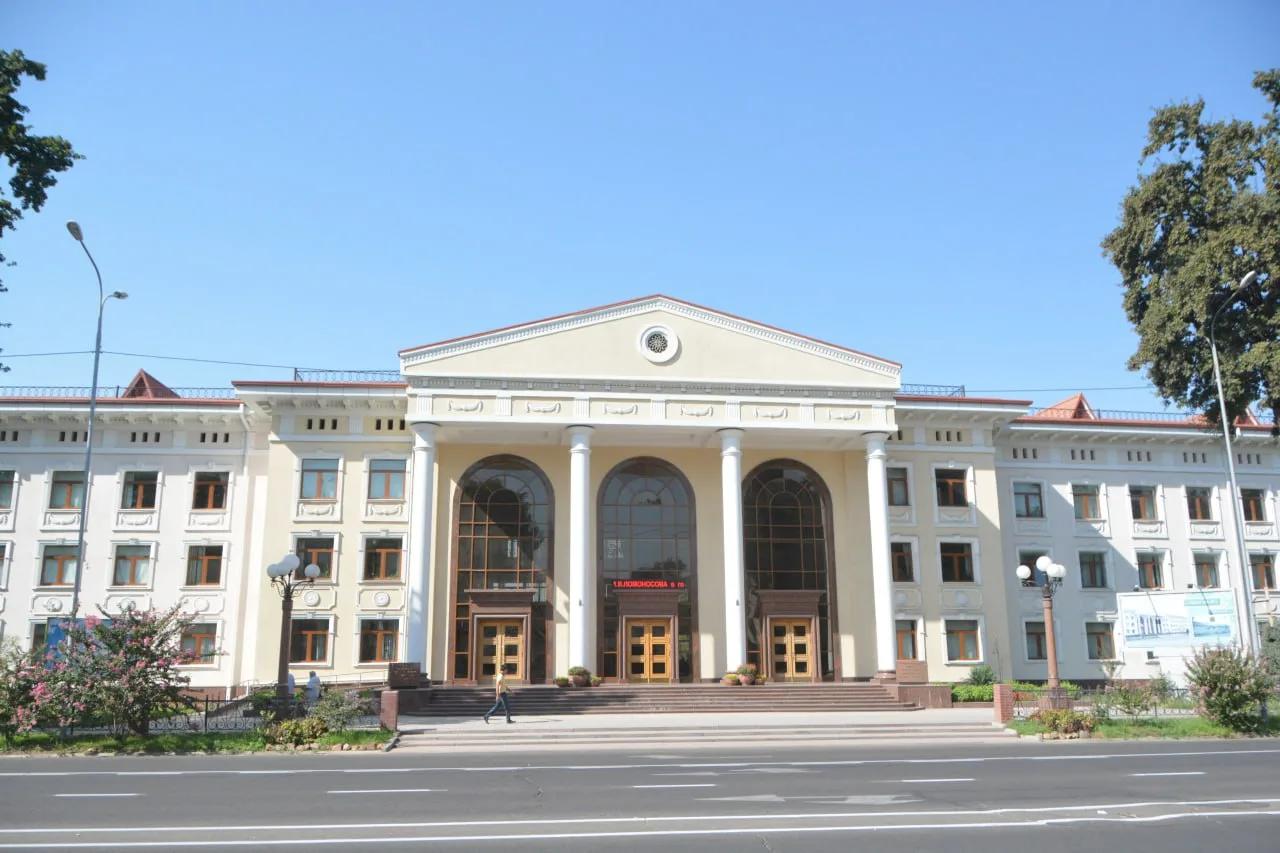
Stories of our graduates.
Studierendenstimmen

test